
Student support
Struggling With Algebra? Why It Feels Hard—and What Helps
Struggling with algebra? Learn what can help students with ADHD, dyslexia, dysgraphia, dyscalculia, or gaps in foundational math skills.
· 6 min read · Vector Mountain Team
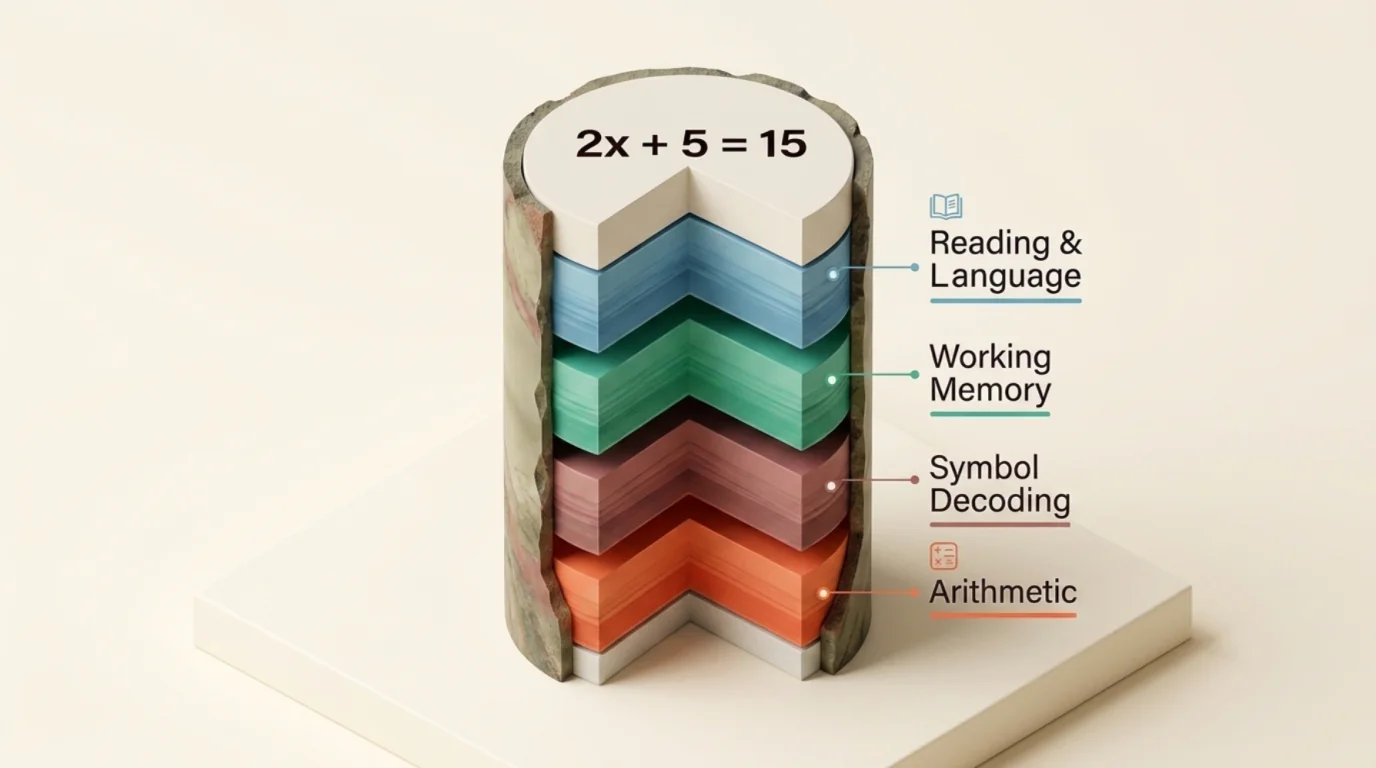
Struggling with algebra does not mean a student is “bad at math.” Algebra combines abstract symbols, multi-step reasoning, reading, handwriting, memory, and attention. A student may understand the main idea and still lose a negative sign, forget an earlier skill, misread a word problem, or run out of focus halfway through the work.
The useful question is not simply, “Why can’t they do algebra?” It is, “Where is the learning breaking down?” Once that point is visible, support can become much more specific.
Why algebra can suddenly feel hard
Algebra asks students to hold several ideas in mind while working with symbols that no longer look like ordinary numbers. The U.S. Department of Education’s evidence-based algebra guidance recommends using solved problems and examining both correct work and common errors. That approach helps reveal what kind of support a student needs:
- They cannot begin: start with a complete worked example and explain why each step happens.
- They lose signs or steps: give feedback on the written process, not only the final answer.
- Older skills keep disappearing: review prerequisite skills and bring them back through spiral practice.
- Reading or attention gets in the way: shorten the learning block and pair spoken explanations with visible math.
How learning differences can change the barrier
Dyslexia, dysgraphia, dyscalculia, and ADHD affect students in different ways. They are not interchangeable, and no single teaching feature works for everyone. But each can add a particular kind of friction to algebra.
Dyslexia: separate the reading from the math
Dyslexia primarily affects reading and language processing, not mathematical ability. The International Dyslexia Association lists audio recordings and text-to-speech among common accommodations. In algebra, spoken explanations can reduce the amount of print a student must decode at once, letting them hear the reasoning while watching the equations change on screen.
Dysgraphia: respond to the work, not the penmanship
The Learning Disabilities Association of America notes that dysgraphia can affect numeral writing and interfere with math. A copied sign, misplaced digit, or reversal can change an otherwise sound solution, although reversals alone do not identify a learning disability. Vector reviews a student’s actual handwritten steps and can flag a possible mismatch it detects, rather than judging only a typed final answer. Students can also use the math keypad when handwriting is not the best input method.
Dyscalculia: rebuild the number foundation
Dyscalculia involves persistent difficulty understanding numbers and math facts. In algebra, that may show up as trouble recalling facts, estimating whether an answer makes sense, or remembering a sequence of steps. Clear modeling, targeted prerequisite review, repeated practice, and specific feedback matter more than simply assigning more problems. A student can ask Vector follow-up questions whenever a step is unclear, but educational software does not diagnose or treat dyscalculia.
ADHD: make the next step manageable
Attention and executive-function demands can make a long lecture or repetitive worksheet especially difficult. The CDC recommends clear instructions, shorter assignments, and timely feedback as useful classroom supports. Short, focused explanations and a predictable lesson routine may help some students stay oriented and return after a break without losing their place.
A better way to restart algebra
- Choose one skill the student cannot yet explain.
- Watch or study one clear worked example.
- Have the student explain the next step out loud.
- Practice a small set and check the written work quickly.
- Review the specific gap before adding more difficulty.
This cycle is more useful than pushing through a large worksheet while the same misunderstanding repeats. Our guide to the research-backed principles of effective algebra instruction explains why worked examples, spiral review, and step-specific feedback belong together.
How Vector Mountain supports that practice loop
- Short explanations: each Learn it section uses four focused videos with audio explanations instead of one long lecture.
- Questions out loud: students can ask Vector whenever they are stuck and hear the answer while seeing the math.
- Feedback on real work: students can write on a tablet or photograph paper work so Vector can respond to the step it reads as incorrect.
- A consistent routine: Warm-Up, Core, and spiral review keep practice manageable, while the optional Challenge Zone and SAT Corner let students push further when ready.
Vector Mountain is a complete Algebra 1 curriculum, not a clinical or diagnostic service. If difficulty remains persistent or affects school more broadly, parents should talk with the student’s teacher, school support team, or a qualified professional. The right evaluation and accommodations can work alongside a better-fitting curriculum.
Frequently asked questions
Why is algebra so hard for some students?
Algebra combines abstract thinking with several prerequisite skills at once. A student may need a missing foundation retaught, a clearer worked example, shorter practice, or feedback on the exact step going wrong.
Can students with dyslexia or dyscalculia learn algebra?
Yes. These learning differences do not determine intelligence or place a ceiling on what a student can learn. Students may need different access to explanations, explicit instruction, more foundational review, suitable accommodations, and additional time.
How can Vector Mountain help a student who gets stuck?
Students receive short video and audio explanations, can ask questions out loud, and can submit handwritten work for step-specific feedback. Families comparing complete programs can also read our homeschool algebra curriculum comparison.